

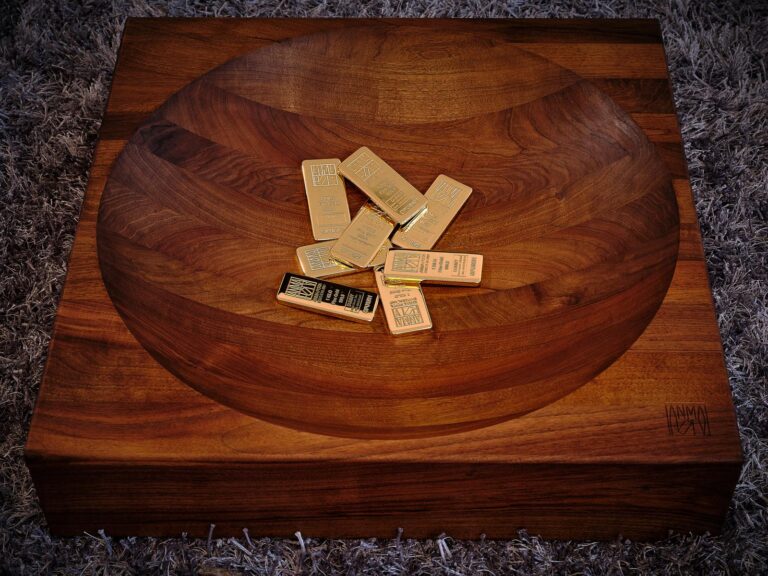
Why Gold, Anma Pota?
I was six or seven years old when I received a Swiss gold coin for Christmas — a Gold Vreneli.
The reaction of those around me was part of the magic.
Suddenly, this small object became something special.
I showed it to everyone: friends, classmates, strangers.
I carried the coin with me — always.
One day, it was gone.
There was searching, agitation, reproach.
The loss intensified its meaning.
It was not the material value that mattered, but the feeling:
gold is more than metal.
The coin reappeared later —
in the toy cash register of my little sister.
She must have been short of small change.
Since then, gold has accompanied me.
Not only emotionally, but also rationally.
All the gold ever mined by humanity would form a cube
with an edge length of around 22 meters —
approximately 120,000 tons.
Gold cannot be multiplied.
It is not consumed.
It does not corrode.
What exists, remains.
It is one of the few materials that can be transformed almost endlessly
without losing its essence. So it is possible that the gold I use today was once worn as a crown, admired as jewelry, or revered as a relic. That potential history alone is fascination in itself.
I am equally captivated by gold as a material.
It can be melted, cast, rolled, hammered, stretched.
It allows for extreme precision as well as archaic force.
It forgives — and at the same time demands the highest level of attention.
Every intervention leaves a trace. Every transformation is reversible.
And of course, there is the idea of value —
carried by rarity and human attribution.
For thousands of years, gold has served as a store of value,
independent of currencies, states, or promises.
In times of stability as well as in moments of upheaval.
All of these qualities interest me as an artist.
I use gold as a working element — as a material that stores memory,
preserves value, and carries meaning. All in the tension between luxury and decadence, between general affordability and real unattainability, with all the facets of extraction, production, trade and use.
I use it, to make emotions and controversies visible.
My works extend gold’s function as a store of value
by adding another dimension: meaning.
My oeuvre aims to carry gold forward —
from history to the present,
from value to meaning,
from material to emotion.
Regarding my comments on the subject of gold, I would also like to draw your attention to the two texts “The Devil’s Splendor” and “The Angels’ Radiance”, especially to my respective “personal remarks” in the introduction to the texts.
LinkedIn
Instagram